 MAD
 An open format and embeddable engine for relational reporting — where every report is a portable query graph, a materialized SQLite table, and a parametric layout.
MAD is an embedded relational reporting platform for ad hoc query, reporting, and design: the MAD Designer and MAD Viewer apps for iOS and native macOS (AppKit), the headless engine that runs them on Linux and macOS, and the open .mad document format. A .mad file holds a report’s whole definition — the database schema snapshot, the query graph (tables, joins, predicates, groupings), and the banded layout of its elements — in under 100 KB, cleanly separated from the materialized SQLite table (.maddb + .mdcache) it produces on refresh.
The code is at github.com/mthomason/MAD, MIT-licensed; the names and app artwork are not covered by that licence (see NOTICE).
Try MAD Designer on macOS (macOS 12.0+, Apple Silicon):
- Homebrew:
brew install --cask mthomason/tap/mad-designer
Direct Download: MAD-Designer-macOS.dmg MAD-Designer-macOS.zip (for direct downloads, run xattr -cr "/Applications/MAD Designer.app"once after copying to/Applications)
See it
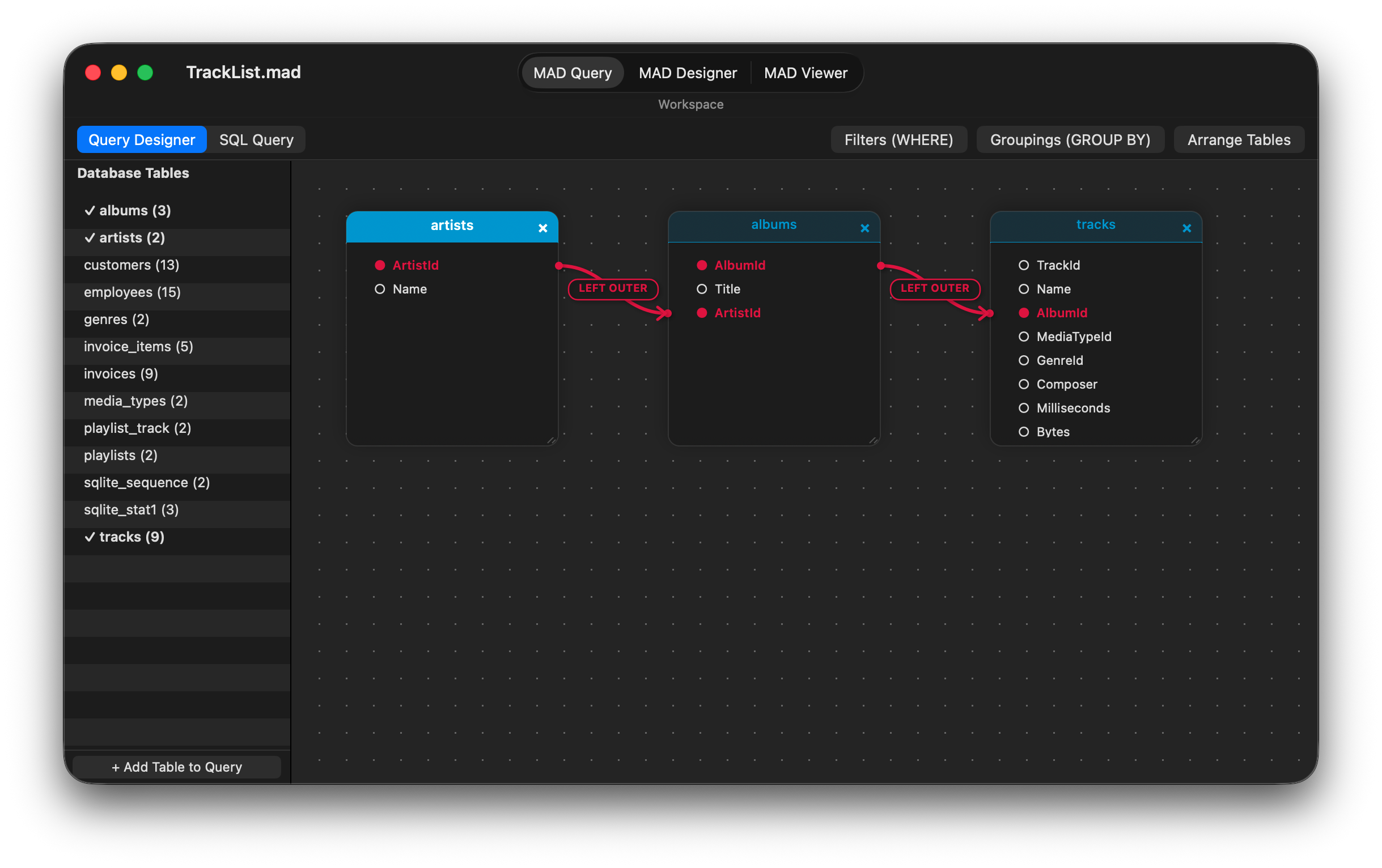
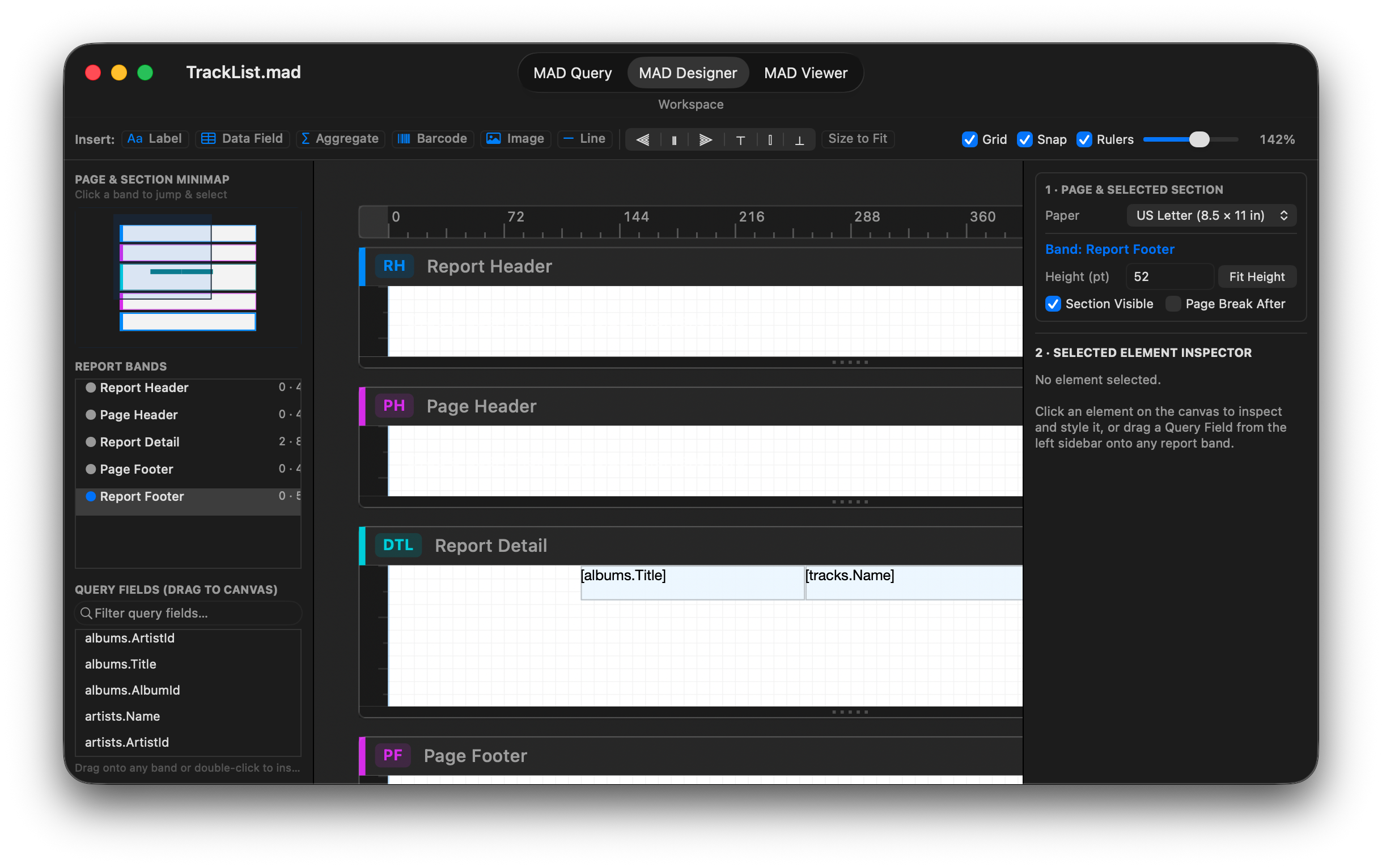
MAD Designer for macOS — native AppKit desktop application (NSDocument, visual table/join query canvas, interactive section minimap and banded report designer, and paginated PDF/HTML/CSV/JSON report viewer):
MAD Designer for iOS, from choosing a data source to reading the finished report in MAD Viewer:
The same engine headless on Linux: inspect, schema, query, refresh, and
export through the mad CLI, with no database server and no credentials:
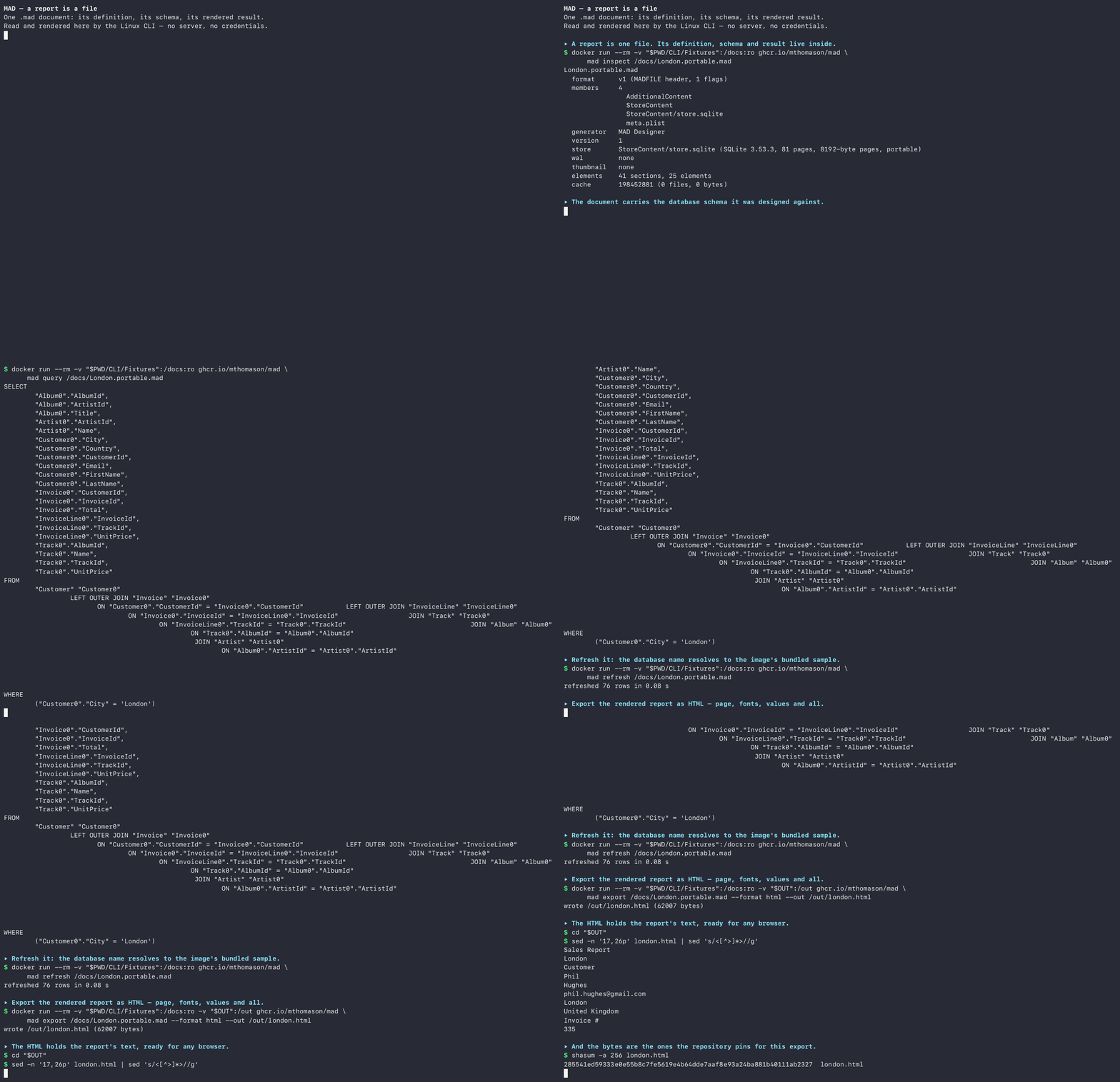
The recording’s exported report is plain HTML, opened in any browser.
Why MAD
- Interoperable by contract. Instead of scattering one-off SQL scripts and
bespoke dashboard glue across an organization, a
.madfile packages the schema contract, the query AST, and the presentation layout into one inspectable, diffable artifact that produces byte-identical SQL and exports across Apple and Linux. - Written, not assembled. The SQL generation, the SQL parser, the
data-table engine, the store, the layout model, and the renderer are
first-party Objective-C across fourteen frameworks. Third-party code is
limited to the wire — MariaDB Connector/C, FreeTDS,
libpq, SQLite — pluslibarchive/bzip2andzintfor barcodes. No reporting SDK is being resold. - Mobile-first, memory-budgeted. A refresh reads the result set once
into a SQLite row cache (
MADDataTableFast) and computes two-pass groupings and aggregates from there, so paginated rendering stays fast within a phone’s memory. - Embeddable and portable. Eleven of the fourteen frameworks are
UIKit-free and build headlessly, passing 1,303 tests on Linux in Docker.
The
.madcontainer is a bzip2 tar archive holding a portable SQLite store; no Apple framework is required to open it.
The .mad format
Read the introduction to the specification first, or jump to a chapter:
What a document is ·
The container ·
The store ·
Reading and writing ·
Companion files ·
Hazards ·
Normative v1 ·
Open questions ·
Verification
Using the engine
- MAD Designer for macOS — the native
AppKitdesktop app: visual query canvas, banded report designer with minimap and inspector, paginated viewer, and how to build or package it from source. - Build and test — the exact commands for the iOS suites, the native macOS suites, and the Linux build.
- The
madCLI — inspect, refresh, and export a.madfrom Docker in one line. - mad-action — run a checked-in
.madin GitHub Actions and upload its export;mthomason/mad-action@v1. - Driver-authoring tutorial — the
intended first contribution: subclass
MADDatabase, register the driver, return rows.
The direction
Vision — reports as composable database tables, multi-source
queries in a single report, native UIKit data views beyond the paper paradigm,
and converting legacy Crystal Reports (.rpt) into open .mad files.
The MAD Designer app — the report designer built on this engine — has its own site at mad.everydayapps.com.